From Schedule to Simulation
BIM, 3D and visual workflows that make complex projects easier to understand.
From Schedule to Simulation: How Spatial Processes Can Be Visualized Beyond Construction
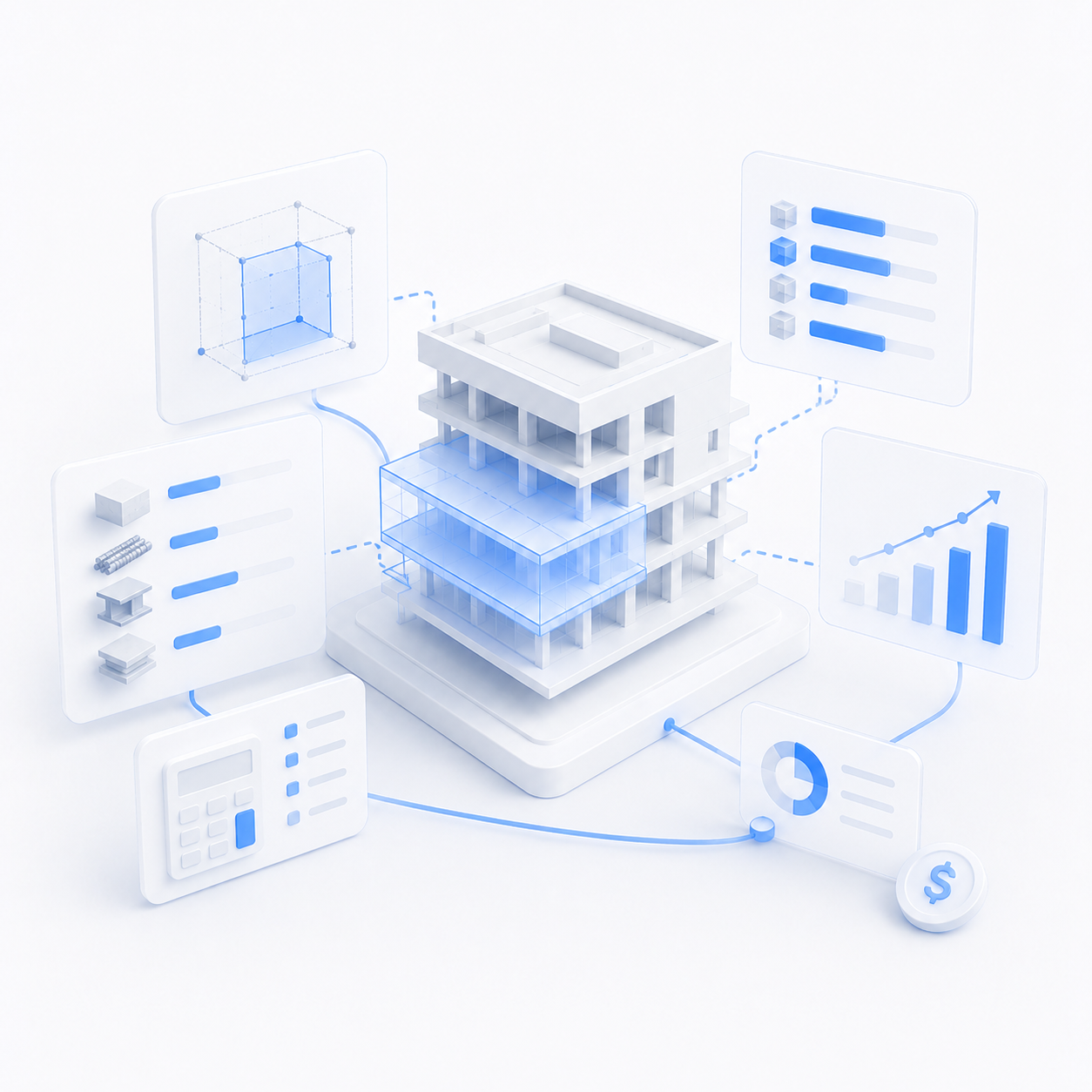
Simulation is often associated with construction: 4D BIM, building phases, cranes, scaffolding and construction progress. But the real principle is broader. A simulation becomes useful when a schedule is connected to a spatial model. The model alone is not enough. The schedule is the driver: what happens, when it happens, where it happens, and which resources, zones, people, equipment or documents are involved. Every line in the schedule can become a visible event inside the model. A storage zone appears for a specific period. A route opens or closes. An event hall is set up. A production line starts. A hotel wing is closed for maintenance. A warehouse reaches peak occupancy. A gate area becomes congested. When needed, these scheduled events can also be connected to cost, resources, quantities, documents or responsibilities. At that point, the simulation is no longer just an explanatory animation. It becomes a way to understand and discuss the plan before it is executed. 1. Warehouses and logistics facilities Warehouses are one of the clearest examples of schedule-driven simulation. They are not static spaces. Their real performance depends on timing: inbound deliveries, loading windows, picking routes, storage availability, dispatch areas, truck movement and peak demand. A simulation can connect the warehouse model to a schedule showing: when trucks arrive; which loading zones are occupied; where temporary storage is needed; how forklift or picker routes change; when bottlenecks appear; how layout changes affect daily operations; which areas are unavailable during maintenance or reconfiguration. Fraunhofer IML describes a digital twin in logistics as a virtual copy of a real object or process that collects data and enables analysis, simulation and optimization. It also notes that logistics digital twins can support route optimization for order pickers and automated systems. For logistics operators, the value is not only seeing a warehouse. The value is seeing how the warehouse behaves over time. 2. Manufacturing and production lines Manufacturing is also schedule-driven. Production lines run in shifts. Machines have maintenance windows. Materials arrive according to supply schedules. Line changes affect space, movement and output. A schedule-linked model can show: when each production line is active; where raw materials are stored; how products move between steps; when a machine is down for maintenance; how a new machine affects circulation; what happens during a layout change; how resources are used across shifts. Siemens describes production digital twins as tools for planning, simulating and optimizing production processes from machines to entire plants. The point is not to replace industrial simulation software. The point is to make operational logic visible to decision-makers before physical changes are made. 3. Events, exhibitions and temporary venues Events are temporary by nature. A venue may be empty on Monday, under construction on Tuesday, open to visitors on Wednesday and dismantled on Friday. A floor plan alone cannot explain this. A schedule-driven simulation can show: build-up phases; stand installation; delivery and service routes; visitor circulation; restricted zones; VIP areas; temporary storage; emergency access; dismantling sequences. Research on sports and event digital twins indicates that they can help organizers simulate and optimize seating arrangements, crowd flow and facility layouts. This is valuable because event problems are often time-based: a route is clear at one hour and blocked the next; a storage area is useful during setup but dangerous during visitor hours. 4. Hotels, resorts and hospitality operations Hotels and resorts are not only real estate assets. They are operational systems. Their spaces change depending on season, event schedules, guest flows, maintenance, staffing and service logic. A simulation can link a hospitality model to: event setup schedules; partial closures; renovation phases; restaurant or banquet preparation; guest movement between reception, rooms, restaurants, spa and outdoor areas; back-of-house logistics; seasonal operation of beach, pool or outdoor zones. For resorts, this can support both presentation and operations. Guests may understand the property better, while operators can test how the property functions during events, peak periods or maintenance windows. 5. Healthcare facilities Healthcare facilities depend heavily on timed processes: appointments, patient flow, room availability, cleaning cycles, emergency access, staff allocation and temporary closures. A schedule-linked simulation can show: patient movement during peak hours; waiting area pressure; room usage over time; temporary department closures; staff and service routes; renovation scenarios during operation; emergency or training procedures. A recent healthcare digital twin framework describes hospital systems as operational patterns that can be modeled and simulated, including the use of historical or real-time data to support scenario analysis. Healthcare use cases require special care: privacy, data quality and clinical responsibility matter. The most realistic starting points are orientation, training, renovation planning and non-personal operational workflows. 6. Airports, ports and transport hubs Airports, ports and transport hubs are impossible to understand without time. Gates, berths, check-in areas, security lanes, vehicles, baggage, cargo, passengers and staff all depend on schedules. A simulation can show: passenger flow over the day; gate or platform occupation; queue formation; baggage or cargo movement; vehicle routes; temporary closures; staff deployment; disruption scenarios. ICAO material on airport digital twins highlights their role in improving data sharing, predictive modeling, traffic-flow optimization and proactive safety and risk management. In these environments, a small delay or closure can have a large spatial effect. That is exactly where schedule-linked simulation becomes useful. 7. Energy and industrial facilities Energy plants, treatment plants, solar farms and industrial utilities often involve installation phases, maintenance windows, safety zones, shutdowns and equipment operation. A schedule-linked model can show: installation phases; equipment activation; maintenance periods; lifting and storage zones; safety exclusions; temporary access restrictions; operating states over time. A systematic review of energy digital twins identifies potential benefits in energy management, optimization, maintenance, energy-efficient design, operation of existing sites and renewable-energy integration. In this sector, simulation is not primarily about presentation. It is about reducing uncertainty in operation, maintenance and risk planning. How Benatrix can support schedule-linked simulation Benatrix can apply this logic when a project needs to explain spatial processes over time. Elements, zones, temporary occupations or activities can be connected to specific periods in a schedule. In the simulation, they appear when they are relevant and disappear when the phase ends. When needed, these events can also be connected to cost, quantities, resources, documents or responsibilities. This makes the model useful not only for construction, but also for logistics spaces, events, resorts, operational buildings and technical facilities. Benatrix does not need to replace specialized industrial simulation tools. Its value is to provide a clear visual layer that helps owners, operators, investors, partners and teams understand what will happen inside a space over time. Conclusion Useful simulation does not start with a beautiful model. It starts with a clear schedule. When scheduled activities become visible inside a spatial model, complex plans become easier to understand, compare and discuss — whether the project is a warehouse, factory, event venue, resort, hospital, airport or energy facility. The value is not that the model moves. The value is that the plan becomes visible before real-world mistakes become expensive.
BIM services